
Pronunciation: ang-kih-LOH-sis
What it means in simple terms:
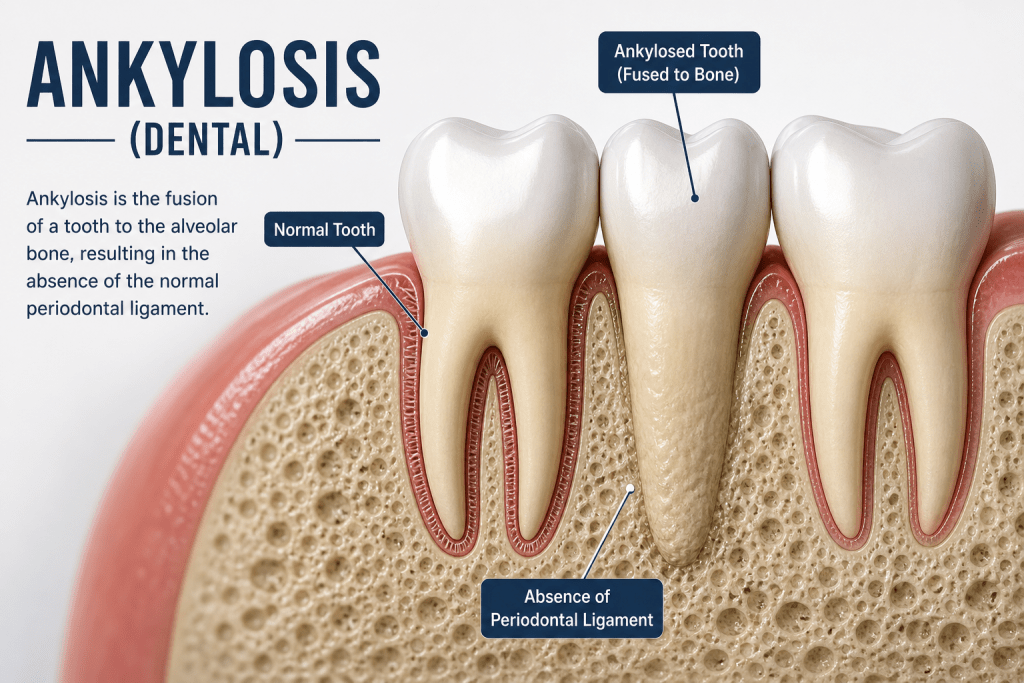
Dental ankylosis is when a tooth gets stuck. Not stuck like it is just being stubborn, but actually fused to the jawbone beneath it. Under normal circumstances, every tooth is held in place by a thin layer of tissue called the periodontal ligament. Think of it like a shock absorber between the tooth root and the bone. When ankylosis happens, that layer disappears and the tooth and bone grow together into one solid unit.
What causes it?
Honestly, dental researchers are still working on a complete answer to this one. What we do know is that it usually starts with some kind of disruption to the root surface, whether from a past injury, an infection, or local inflammation. Instead of healing the way it should, the area fills in with bone. Genetics can also play a role, since it tends to run in families. Trauma to the jaw is one of the more commonly identified triggers.
Who tends to get it?
Children are far more likely to experience this than adults. The lower back baby molars are the most commonly affected teeth. It is much rarer in permanent teeth, but it does happen. In most cases, it gets picked up because a baby tooth simply will not budge when it should have fallen out months ago.
What does it look like?
This is actually one of the more visually striking signs. Because the ankylosed tooth is locked in place, it cannot keep up as the surrounding teeth and jawbone continue to grow. The result is that the tooth looks like it is slowly sinking below the gumline while everything else rises around it. The neighboring teeth may also start to lean toward that sunken tooth, filling the space.
What happens if it goes untreated?
In children, the biggest concern is the permanent tooth that is waiting underneath. If the baby tooth is fused to the bone and blocking the way, the adult tooth can become impacted or erupt in the wrong direction entirely. The teeth on either side may also drift and tilt, and the jaw can develop unevenly over time. In adults, the issue tends to progress more quietly but still warrants attention.
As a Dental Hygienist of 20 years I have seen this in a clinical setting and this is why it is so important to get dental check up, dental exams and dental X-rays.