
If you got a dental bridge and now you can’t figure out how to floss it, you are not doing anything wrong. The reason regular flossing does not work on a bridge is built into the way bridges are made. Once you understand that, the fix is simple.
I’m a registered dental hygienist with over 20 years of clinical experience, and bridges are one of the top reasons patients tell me they stopped flossing. They tried to floss but the floss would not go down, they gave up, and now they are worried something is wrong. Nothing is wrong. You just need a different tool and a different motion.
Here is what is actually going on under your bridge, why it matters, and the step by step way to clean it.
What a Bridge Actually Is
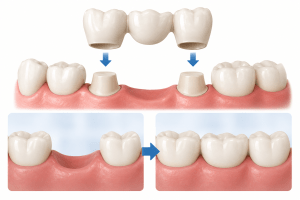
A dental bridge fills the space where a tooth used to be. The most common type uses the two teeth on either side of the gap as anchors. Those anchor teeth get crowns on them, and a fake tooth in the middle is fused to both crowns. The whole thing is one solid piece.
The fake tooth in the middle is called a pontic. The pontic sits on top of your gum, but it is not attached to your gum or to bone. It just rests there.
This is the key thing to understand. There is no space between the pontic and the crowns next to it. The three teeth are connected like train cars. So when you try to push floss down between them, the floss has nowhere to go. That is why it feels like a wall.
Why You Cannot Skip Cleaning Under It
Here is the part most people are not told. The area where the pontic touches your gum is one of the dirtiest spots in your mouth. Food and bacteria collect there all day, and your toothbrush cannot reach it.
When that area is not cleaned every day, a few things start to happen. Your breath gets bad. The gum under the pontic gets puffy and red. The two anchor teeth under the crowns can start to get cavities at the gumline, where the crown meets the tooth. And the bone under everything can start to shrink.
Once an anchor tooth gets a cavity under a crown, the whole bridge usually has to come off. Bridges are expensive. Cleaning under it for two minutes a day is the cheapest insurance you will ever buy.
The Three Tools That Actually Work
You need to clean under the pontic, not between the teeth. So you need a tool that can get under there sideways instead of from the top down.
There are three tools that do this well. Most people only need one. Pick the one that fits your life.
Tool 1: A Floss Threader
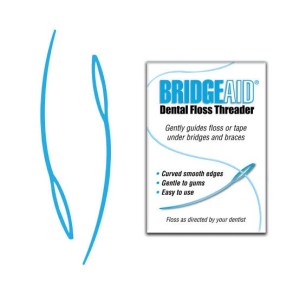

A floss threader is a thin plastic loop that looks like a sewing needle. You put a piece of regular floss through the loop, then poke the pointed end of the threader through the small opening between your gum and the bottom of the bridge. Pull the threader through. Now the floss is under your bridge.
From there you can pull the floss back and forth like a shoeshine motion, then up against each anchor tooth in a C shape. Pull one end of the floss out and you are done with that bridge.
Floss threaders are cheap. A bag costs around five dollars and lasts months. The downside is they are slow and a little fiddly the first few times. Most people get the hang of it in about a week.
Tool 2: Super Floss
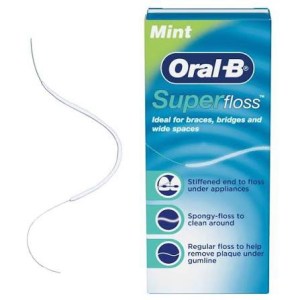
Super Floss is a smarter version of the threader idea. Each piece is already cut to the right length and has three parts built in. One end is stiff like a needle, so you do not need a separate threader. The middle is a fuzzy spongy section that cleans under the pontic. The other end is regular floss for finishing along the anchor teeth.
Most patients I work with find this easier than the threader system. You grab one piece, thread the stiff end under, pull through, and clean. Done. Oral B makes the most common version. You can also find similar products from GUM and Plackers labeled for bridges and implants.
If you are going to floss your bridge every day for the next ten years, Super Floss is usually the tool that gets you there.
Tool 3: A Water Flosser

A water flosser shoots a thin stream of water at high pressure. You aim it where the pontic meets your gum and let the water push food and plaque out from under the bridge.
A water flosser is the fastest option. It is the best choice if you have arthritis, if you have several bridges, if you have implants too, or if you just know yourself well enough to know you will not use a threader.
Here is the part most articles get wrong. A water flosser flushes the area, but it does not scrub it the way floss does. Plaque is sticky and the water alone does not fully break it up. If you are using a water flosser, you still want to run actual floss under the bridge a few times a week. The water handles the daily debris. The floss handles the film.
Step by Step: How to Floss Under Your Bridge
Here is the basic method using a floss threader or Super Floss.
Step 1. Cut a piece of floss about 18 inches long, or grab one strand of Super Floss. If you are using a threader, push the floss through the loop until the floss is doubled over by a few inches.
Step 2. Find the small triangle space between the side of the pontic (fake tooth) and the gum. Slide the stiff end of the threader or Super Floss through that space from the cheek side to the tongue side.
Step 3. Pull the floss all the way through until you have a few inches on each side and the cleaning section is under the pontic.
Step 4. Move the floss back and forth under the pontic in a shoeshine motion. You want to feel it sliding along the underside of the fake tooth. Do this five or six times.
Step 5. Wrap the floss around one anchor tooth in a C shape and slide it up and down along the side of that tooth. Then do the same against the other anchor tooth.
Step 6. Let go of one end of the floss and pull it out from the other side. Do not try to pull it back out the way it came in. Just let it slide free.
That is one bridge. The first time it might take you two minutes. By the end of the first week you will be doing it in 20 seconds.
When Flossing Your Bridge Feels Impossible
Some bridges are harder than others. If you have tried with the right tools and you still cannot get under there, one of these is usually the reason.
The contact is too tight. Sometimes the pontic sits so close to the gum that there is no opening to get the floss through. This can happen right after a bridge is placed, before the gum has fully settled. It can also happen if the bridge was designed without enough clearance underneath. Give it a few weeks. If you still cannot get under it after a month, ask your dentist to check the design.
If you have a bridge then getting a dental cleaning and check-up every 3-4 months is recommended.
