
By Avalene | RDH, Avalener.com
We can all agree that oral care is very important. I’ve been a registered dental hygienist for over 20 years, and one of the most common things I see in practice is people brushing their teeth first. The average person is brushing first, then flossing, then maybe scraping their tongue if they remember. And I totally get it because that’s what most of us were taught, or at least that’s what felt we should be doing. At one point that’s what I use to do myself before I became a Dental Hygienist.
But here’s the truth: the order actually matters. The science backs it up. And once you understand why, you won’t be able to go back to doing it the old way, TRUST.
🦷 The Correct Order: Floss → Water Floss → Tongue Scrape → Brush. (IKR)
Step 1: String Floss First

Before anything else touches your teeth, reach for your floss. This is the step that loosens everything hiding between your teeth: the plaque biofilm, the food debris, the bacteria your toothbrush will never reach on its own.
A randomized controlled clinical trial published in the Journal of Periodontology found that flossing before brushing significantly reduced interdental plaque compared to brushing first, and also resulted in higher fluoride retention in those interdental spaces after brushing. That means flossing first not only clears more plaque but also helps your toothpaste work harder by making it easier for fluoride to reach between your teeth where cavities most often form. (Mazhari et al., 2018, PubMed ID: 29741239)
A second clinical trial published in Oral Health and Preventive Dentistry confirmed the same finding. When participants flossed before brushing, their plaque control and gingival health scores were significantly better than when they brushed first. (Torkzaban et al., 2015, PubMed ID: 25197738)
“Floss before you brush. Think of it like sweeping before you mop. You want to loosen everything first so the brush can clear it all away.”
Step 2: Water Floss Second
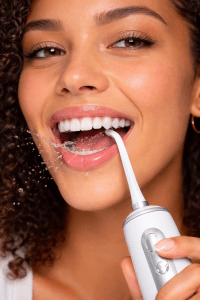
Once you’ve mechanically disrupted the plaque with string floss, follow up with your water flosser. This is the power rinse step. The pulsating water pressure flushes out everything that the string floss just loosened, and it also reaches below the gumline in a way that string floss cannot. I use a water flosser every single day and my mouth feels like I had a professional dental cleaning.
A 2013 study published in the Journal of Clinical Dentistry found that water flossers were 29% more effective at removing plaque after a single use compared to string floss alone. Research cited by the American Academy of Periodontology also supports the use of oral irrigators as an effective adjunct to string flossing for plaque control.
The key word here is adjunct. Water flossing does not replace string flossing. String floss physically scrapes the biofilm off the tooth surface in a way that water pressure alone cannot replicate. But when you combine both, you are covering every base: mechanical removal followed by a thorough flush.
“Think of string floss as the scrub and the water flosser as the rinse. You need both, and the order is not interchangeable.”
Step 3: Tongue Scrape Before You Brush
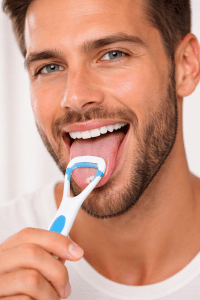
Your tongue is a reservoir. It holds onto bacteria, dead cells, and food debris in the papillae (those little bumps across the surface), and that coating is one of the primary drivers of bad breath and oral bacterial load. Most people skip this step entirely, and even those who do it often do it after brushing, which makes less sense when you think about it.
Scraping your tongue before you brush means that all of that bacteria gets physically removed before your toothbrush moves it around your mouth or your toothpaste tries to work around it. Doing this daily also really helps reduce bad breath. Just make sure that you are not applying too much pressure.
A crossover clinical trial published in the Journal of Periodontology (Pedrazzi et al., 2004, PubMed ID: 15341360) found that tongue scrapers reduced volatile sulfur compounds (VSCs) by 75%, while a toothbrush used on the tongue achieved only a 45% reduction. This really shows that using a tongue scraper can help with bad breath compared to just using your toothbrush to clean your tongue.
“Scraping your tongue before you brush is like clearing the table before you wipe it down. Remove the debris first so your brush can do a clean sweep.”
Step 4: Now You Brush

After you have loosened and flushed the interdental plaque, cleared the tongue, and disrupted the biofilm throughout your mouth, now you pick up your toothbrush. This is where your fluoride toothpaste gets its moment to truly work because every surface it touches has already been prepped.
Brushing last means the fluoride has a cleaner surface to coat and protect. It means the debris your floss loosened is not just being swept around your mouth but has already been cleared. And it means your two minutes of brushing are actually two productive minutes instead of two minutes spent pushing plaque around a mouth that was never prepped.
Brush for a full two minutes, twice daily. Use a soft-bristled brush and fluoride toothpaste. After brushing, spit but do not rinse with water immediately. Allowing the fluoride to sit on the tooth surface for a few extra minutes increases its effect.
The Bottom Line
Your oral hygiene routine is only as effective as the order you do it in. Here’s what 20+ years of clinical experience and the peer-reviewed research both agree on:
- String floss first to mechanically break down and loosen interdental plaque
- Water floss second to flush out everything that was just loosened
- Tongue scrape third to remove the bacterial reservoir sitting on your tongue
- Brush last so your fluoride toothpaste can work on the cleanest possible surfaces
This is not about being perfect. It is about being smart. You are already taking the time to do your routine, so you might as well do it in the order that gets you the best results.
Your mouth will thank you.
References
Mazhari F, Boskabady M, Moeintaghavi A, Habibi A. The effect of toothbrushing and flossing sequence on interdental plaque reduction and fluoride retention: A randomized controlled clinical trial. Journal of Periodontology. 2018;89(7):824–832. PubMed ID: 29741239.
Torkzaban P, Arabi SR, Sabounchi SS, Roshanaei G. The Efficacy of Brushing and Flossing Sequence on Control of Plaque and Gingival Inflammation. Oral Health and Preventive Dentistry. 2015;13(3):267–273. PubMed ID: 25197738.
Pedrazzi V, Sato S, de Mattos MG, Lara EH, Panzeri H. Tongue-cleaning methods: a comparative clinical trial employing a toothbrush and a tongue scraper. Journal of Periodontology. 2004;75(7):1009–1012. PubMed ID: 15341360.
Lee JS, et al. The Effect of Mechanical Tongue Cleaning on Oral Malodor and Tongue Coating. PMC. 2022. PMC8751028.
Goyal CR, Lyle DM, Qaqish JG, Schuller R. Evaluation of the plaque removal efficacy of a water flosser compared to string floss in adults after a single use. Journal of Clinical Dentistry. 2013;24(2):37–42.
American Academy of Periodontology. New Study Suggests the Ideal Sequence for Removing Plaque. AAP Press Release. August 29, 2018. perio.org.
